१What is Chhathi?
Chhathi (छठी, also Chhati or Shashthi puja) is the small family ceremony on the sixth day after a baby is born. The family thanks Shashthi Devi — Chhathi Mata, who in the Puranas protects newborn children, and prays for the baby's long and healthy life.
In many families it is also the night of Vidhata (Bemata): a blank page, a pen and kumkum are kept by the baby's head, because Vidhata is believed to write the child's destiny on the sixth night. It is often the first time the mother and baby are dressed in new clothes and meet the wider family.
ParamparaShashthi Devi as the protector of children is described in the Puranas; the Vidhata custom is a widely followed family tradition.
२Where in the home
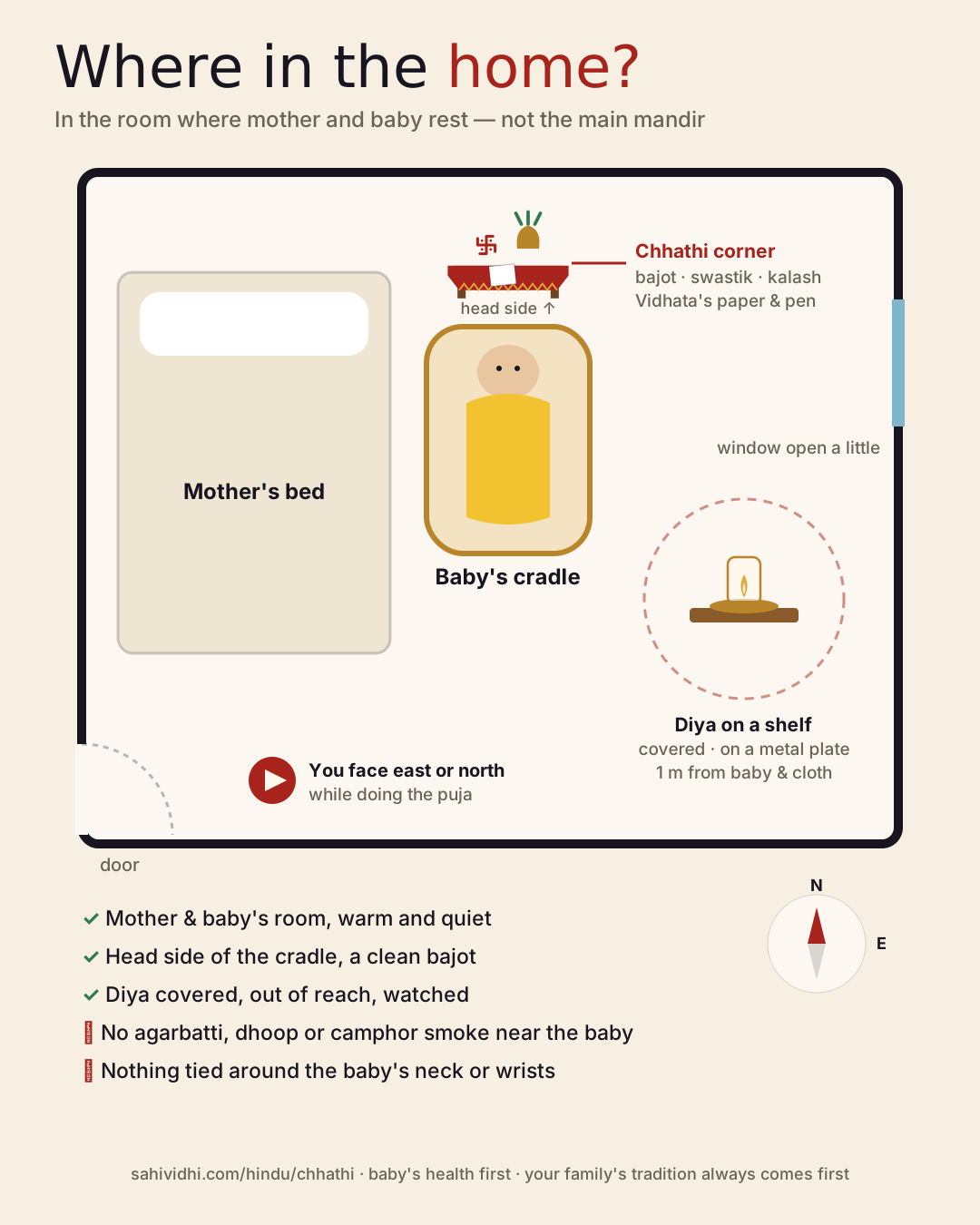
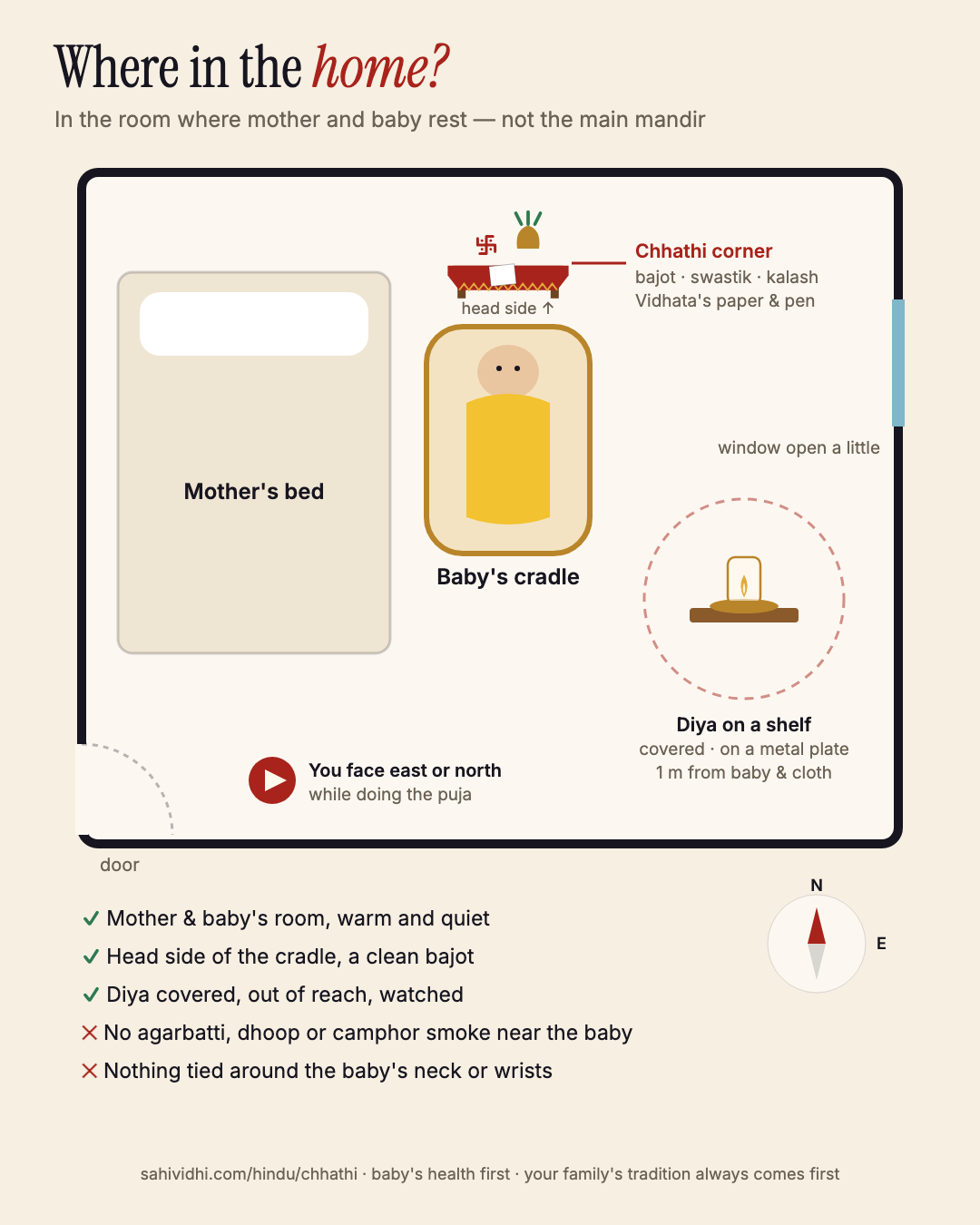
- The room where mother and baby rest. Chhathi is done where the baby sleeps, not at the main home mandir. Many families keep the mandir closed during the birth sutak.
- At the head side of the cradle or bed, on a clean bajot (low stool) or a plate on a small table. This is the "Chhathi corner".
- Face east or north while you do the puja, if the room allows it. If not, any clean corner is fine — the bhav matters more.
- The diya goes up, not down: on a shelf or high table, covered, on a metal plate, about a metre from the baby and away from curtains and bedding.
Download image Share on WhatsApp
३In 8 pictures
Download image Share on WhatsApp
Each step in detail, with mantras
The sixth day, in the evening
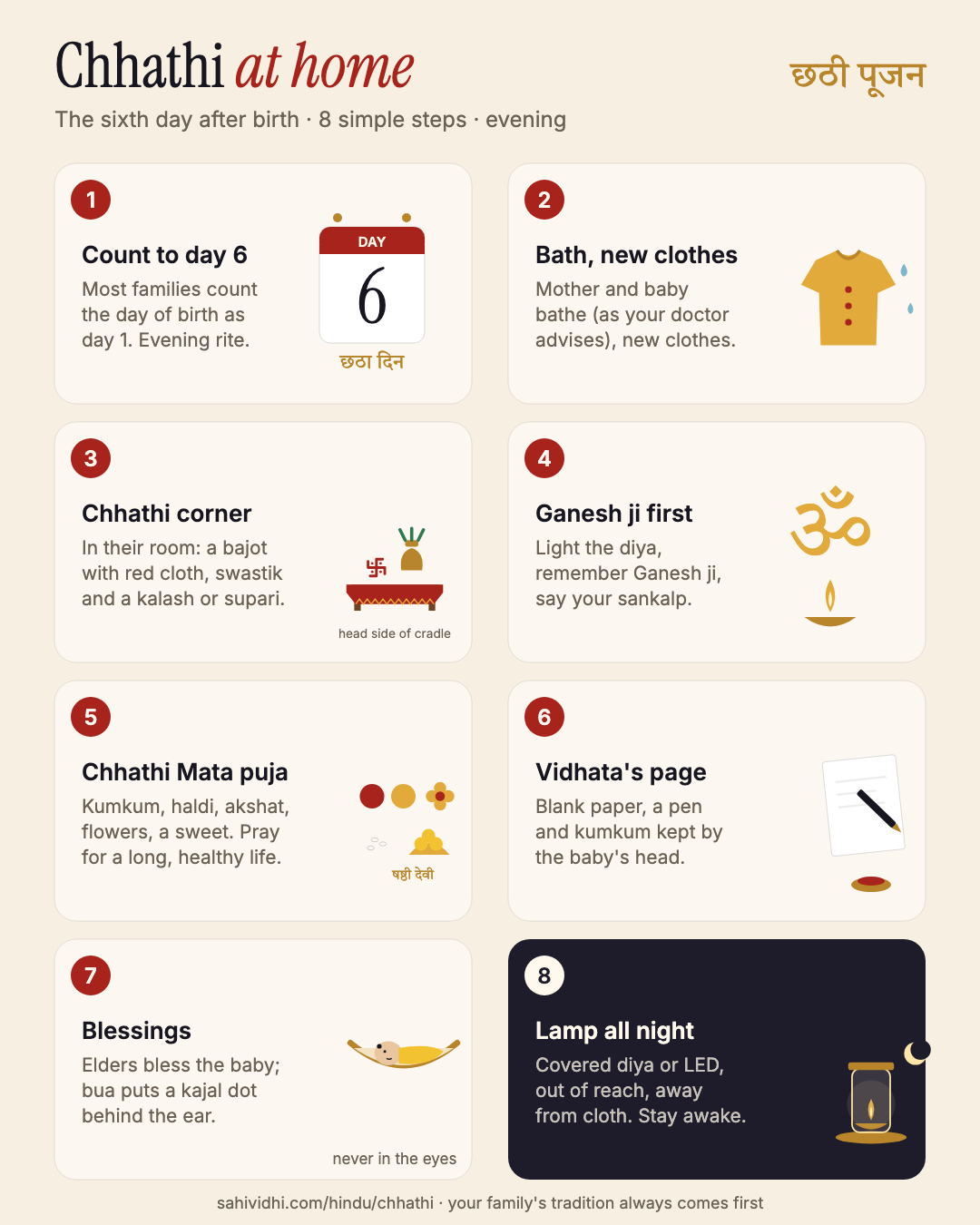
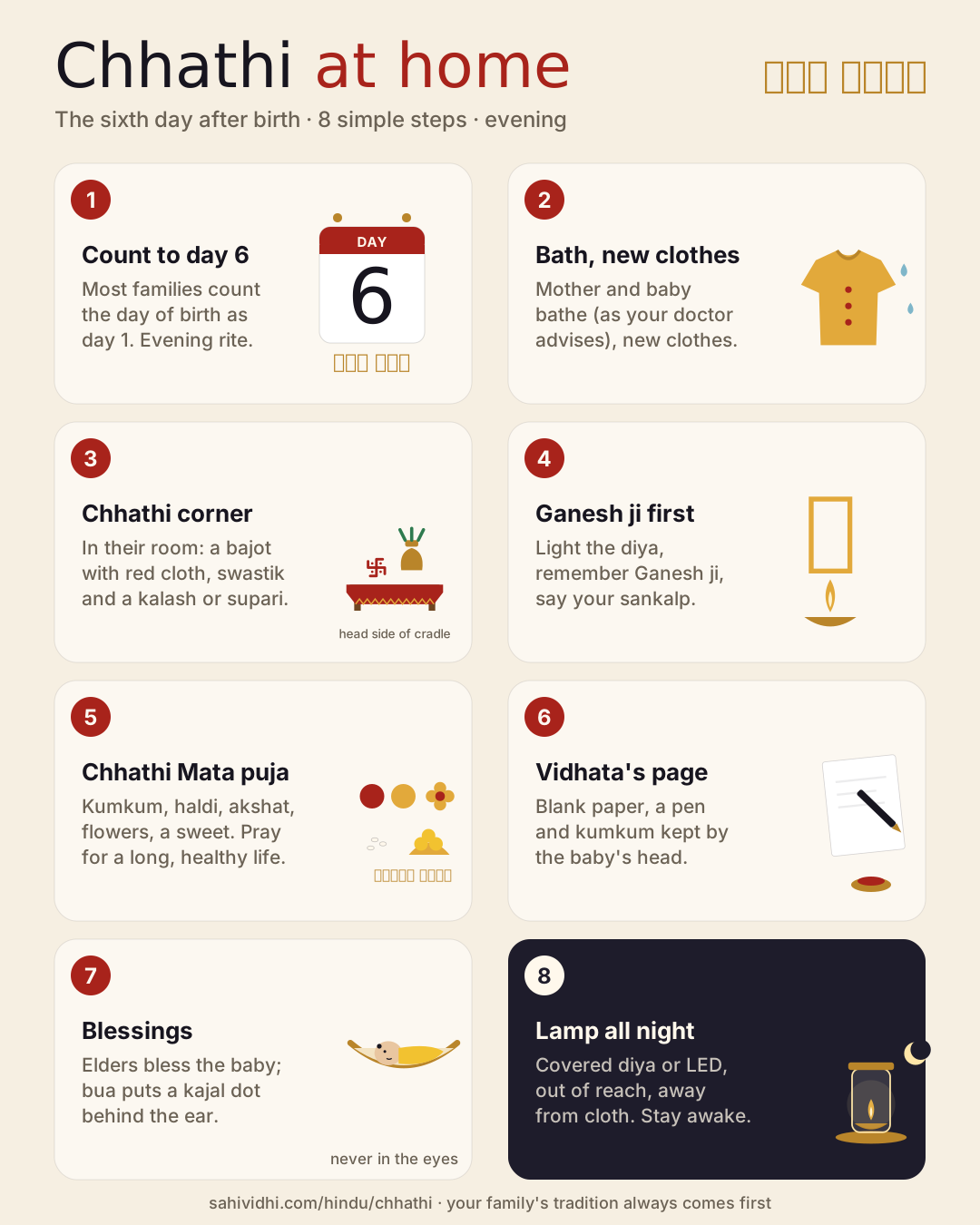
Count the day of birth as day 1 (most families) — Chhathi is on day 6. The puja is done in the evening, after sunset, and the lamp stays lit through the night. Use the date finder above if you're unsure.
Bath and new clothes
The mother and baby bathe and wear fresh new clothes — in many families the baby's first clothes come from the nanihal (mother's parents). Until the umbilical cord falls off, a gentle sponge bath is enough; follow your doctor or midwife. Clean the room and keep it warm.
Set the Chhathi corner
At the head side of the baby's cradle, place a clean bajot with a red cloth. Draw a swastik with kumkum. Place a small kalash with water, or a whole supari on akshat, as Chhathi Mata. Keep Vidhata's blank page, the pen and a little kumkum on the bajot.
Light the diya and begin with Ganesh ji
Light the ghee diya (covered, out of reach). Remember Ganesh ji, then say your sankalp: your names, the place, and that you are doing the Chhathi puja for your child's long and healthy life. If the baby has been named, say the name.
ॐ गं गणपतये नमःOm Gam Ganapataye NamahSalutations to Ganesh ji, remover of obstacles.Puja of Chhathi Mata
Offer kumkum, haldi, akshat and flowers to the kalash or supari, then a sweet as naivedya. The mother, with the elders, folds her hands and prays for the child's health, protection and long life.
ॐ षष्ठी देव्यै नमःOm Shashthi Devyai NamahSalutations to Shashthi Devi, protector of children.Vidhata's page
Leave the blank page, the pen (open, or dipped in kumkum) and the kumkum on the bajot near the baby's head for the night. Many families keep this page the next morning as a keepsake of the child's first night of blessings.
Blessings and nazar
Elders bless the baby and the mother. In many families the bua (father's sister) puts a tiny kajal dot behind the baby's ear or on the forehead — never inside the eyes — and gives a gift. Women of the family sing; share the sweets as prasad.
A lamp through the night
The Chhathi lamp stays lit through the night in many families, and someone stays awake with the mother and baby (family members take turns). Use a covered diya on a metal plate up on a shelf, or a battery LED diya — the blessing is the same. In the morning, keep Vidhata's page safely and offer the flowers to a plant.
४What you need
For the puja
- Roli / kumkum
- Haldi
- Akshat (unbroken rice)
- Moli / kalava
- 1–2 whole supari · or a small kalash with water
- Red cloth for the bajot · any clean red or yellow cloth
- A sweet: mishri, peda or laddoo
- Fresh flowers
For the night
- Ghee diya with a glass cover · or a battery LED diya
- Metal plate to stand the diya on
- Blank paper or a small notebook — Vidhata's page
- A pen · or a new kalam
- Kajal, only for a dot behind the ear
- New clothes for the mother and baby
ParamparaMissing an item? Offering akshat in its place, with that intention, is the accepted practice.
५Family customs
In Gujarati families
Chhathi (છઠ્ઠી) is the night of Vidhata: paper, pen and kumkum by the baby's head, a lamp through the night, and the family staying awake. The foi (father's sister) has a special place, and in many families gives the baby's name on the Namkaran, often the 12th day.
In families from UP, Bihar and MP
Chhathi is often a bigger celebration: the mother's ceremonial bath, new clothes from the nanihal, kajal by the bua, sohar songs by the women of the family, and a meal for relatives. Some families name the baby on this day.
In Marathi families
Many families do a similar puja of Satvai devi on the fifth or sixth night, with a lamp and the family keeping watch.
Your family's way
If an elder in your family remembers how it was done for you or your siblings, that is the best guide. Use this page for what you don't remember.
६Baby safety, with tradition
- Flame: a covered diya on a metal plate, on a high shelf, about a metre from the baby and away from cloth — or an LED diya. Never leave a flame unwatched; take turns staying awake.
- Smoke: skip agarbatti, dhoop and camphor in the baby's room; a newborn's lungs are delicate. Keep a window slightly open.
- Kajal: doctors advise against kajal or surma inside a newborn's eyes. A tiny dot behind the ear keeps the tradition safely.
- Nothing around the neck or wrists of a newborn — tie the moli on the cradle instead.
- Visitors: keep the gathering small and ask everyone to wash hands before holding the baby.
- C-section or still in hospital? The mother's rest comes first. Do a small version at home later that evening, or on a day the doctor says is fine.
७Questions people ask
Do we count the day of birth as day 1?
Most families do, so a baby born on a Monday has Chhathi on Saturday. Some count from the next day. Both are followed; ask the eldest in your family.
Can we do Chhathi during sutak?
Yes — Chhathi is itself part of the days after birth. Many families keep the main mandir closed during the birth sutak and do the Chhathi puja in the mother's room, as shown above. Ask your family pandit if you're unsure.
Who does the puja?
Usually the mother, with the grandmothers and elder women of the family; the father joins in. The bua or foi often has a special role.
Is it the same for a baby girl and a baby boy?
Yes. Chhathi is for every child.
Is the baby named on Chhathi?
Some families name the baby on Chhathi; many do the Namkaran on the 11th or 12th day. Follow your family's custom.
We live abroad and the hospital or flat doesn't allow flames.
Use a battery LED diya and keep everything else the same. The bhav — the family gathering to pray for the child — is what matters.
What do we do with Vidhata's page afterwards?
Many families keep it safely with the baby's first things. Some fold it and keep it in the home mandir after the sutak ends.
Another question? Ask Sahayak, our AI helper, or ask Maharaj ji on WhatsApp.
८Sources
- Shashthi Devi as the protector of children: the Puranas. Background reading: Shashthi ↗ on Wikipedia.
- Chhathi as performed in Gujarati and North Indian homes, simplified from family practice.
- Newborn safety notes follow common paediatric advice on flames, smoke and kajal; ask your doctor about your baby.
Also see: Chhathi Vidhi Box · Home Mandir Setup
 Chhathi