
१Where in the home
Imagine your home from above, divided into nine squares. Stand in the middle of the home and use the compass on your phone to find north.
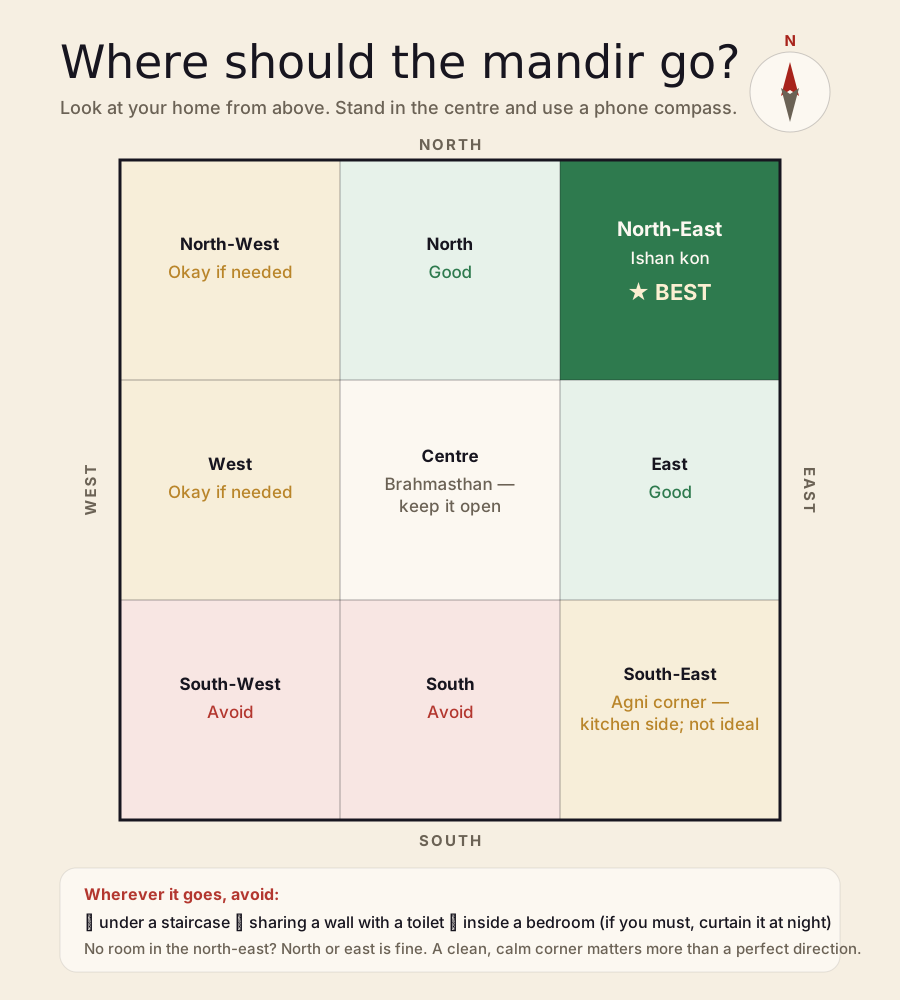
- North-east (Ishan kon) is best. It is the corner of morning light and is linked with Ishan, a form of Shiva.
- North or east are good if the north-east isn't possible.
- West or north-west are acceptable when nothing else works.
- Avoid the south and south-west. Nearly every Vastu source agrees on this.
- Keep the centre of the home (Brahmasthan) open and uncluttered.
ParamparaNorth-east placement is the standard Vastu guidance for a puja room.
Good places
- A quiet corner of the living room
- A separate puja room or alcove
- A wall shelf or cupboard mandir in the north-east
Avoid
- Under a staircase
- A wall shared with a toilet or bathroom
- Inside a bedroom (if you must, curtain it at night)
- The basement
२Which way to face
You and the deity face each other, so choose by the direction you face while praying.
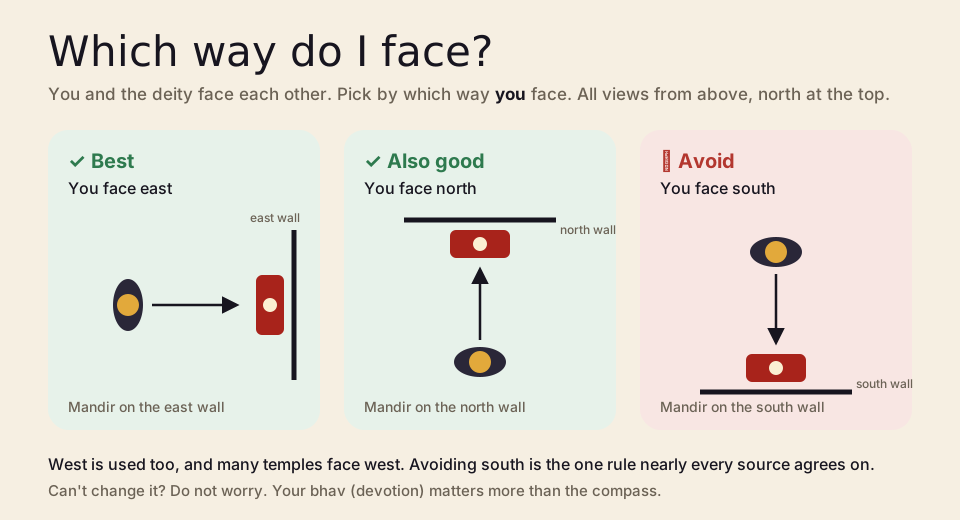
- Best: you face east, the direction of the rising sun. Place the mandir on the east wall.
- Also good: you face north. Place the mandir on the north wall.
- Avoid facing south while you pray.
ParamparaFacing east or north during puja — a standard rule in puja paddhatis.
३What goes where
The front view, as you sit before your mandir:
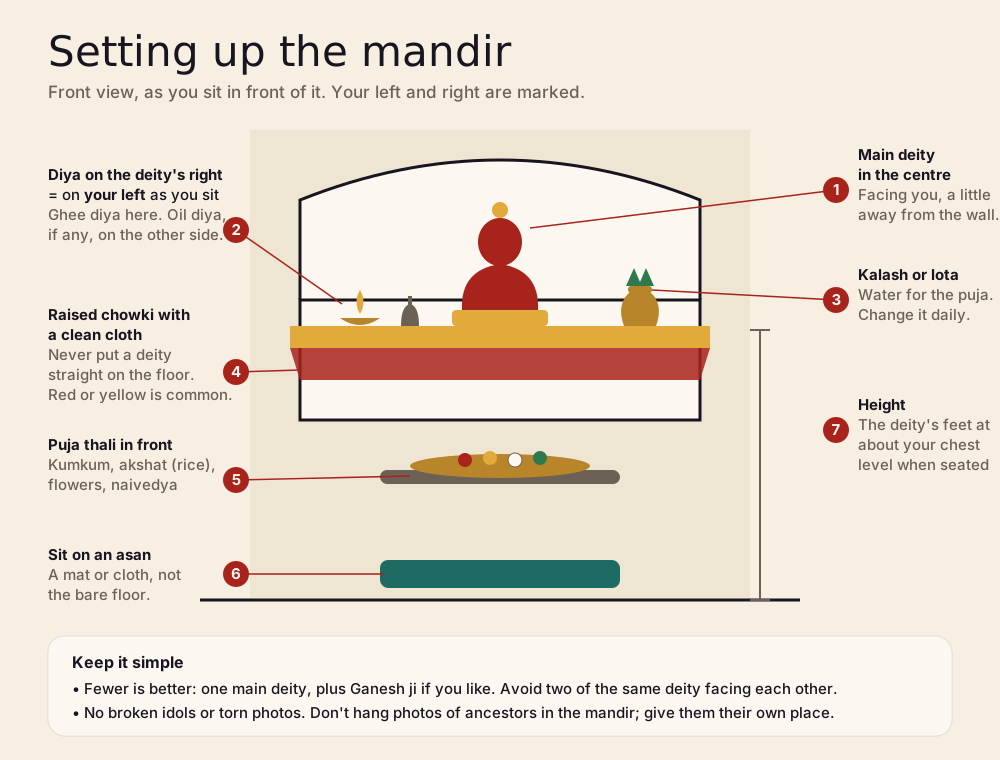
Main deity in the centre
Facing you, a little away from the back wall rather than touching it. Your family deity (kuldevta or kuldevi) or your ishta devta.
Diya on the deity's right
That is your left as you sit. A ghee diya goes here; an oil diya, if you use one, on the other side. One wick is enough for daily puja.
ParamparaPlacement of the diya varies between families.
Kalash or lota of water
Clean water for the puja. Change it every day.
A raised chowki with a clean cloth
Never place a deity straight on the floor. Red or yellow cloth is common.
Puja thali in front
Kumkum, akshat (whole rice), flowers and naivedya (food offering), with a bell.
An asan for you
Sit on a mat or folded cloth, not the bare floor.
The right height
When you sit, the deity's feet should be at about your chest level. Not so high that you look up at it, and never below you.
४Small flats & abroad
- No puja room? A wall shelf or a small wooden mandir in a clean corner is enough. A cupboard mandir with doors works well — close the doors at night.
- Can't use the north-east? Choose the cleanest, calmest spot you have, and face east or north while praying.
- Smoke alarm nearby? One small ghee diya rarely sets it off. Camphor, many lamps and dhoop in a closed room do. Keep flames away from the alarm, open a window a little, and never cover or switch off the alarm. Where open flames aren't allowed, an LED diya and electric dhoop are acceptable.
- Renting? Check your lease rules on open flames and incense, and use a heat-proof plate under the diya.
५Idols & photos
- Fewer is better. One main deity, and Ganesh ji if you like. A crowded mandir is hard to keep clean and to worship properly.
- Avoid keeping two images of the same deity facing each other.
- Keep idols small at home. Large idols are traditionally for temples.
- Photos are fine. A framed picture is a complete and proper focus for daily puja.
- Ancestors' photos don't belong in the mandir. Give them their own respectful place elsewhere in the home.
- Gifted idols piling up? Keep the ones you worship and offer the rest to a temple.
- A broken idol or torn photo should not stay in the mandir. Wrap it in a clean cloth, ask for forgiveness, and immerse it in clean water or bury it under a tree. Abroad, many temples accept them.
६Daily care
- Wipe the mandir every day before puja. Keep the space around it free of clutter, shoes and dustbins.
- Change the water and flowers daily. Remove wilted flowers.
- Old flowers and offerings (nirmalya) never go in the household rubbish. Collect them in a separate basket, then put them under a tree, in a plant pot, or in compost.
- Store only puja items in or under the mandir.
Whatever offering you can manage is enough. In the Gita, Bhagwan says He accepts even a leaf, a flower, a fruit or a little water, when it is offered with devotion.
ShastraBhagavad Gita 9.26 — “patraṁ puṣpaṁ phalaṁ toyaṁ…”
७Questions people ask
My mandir faces south and I can't move it. What should I do?
Don't worry. Keep doing your puja with devotion. If you can, sit so that you face east or north while praying, even if that means sitting to one side of the mandir. Your bhav matters more than the direction.
Can the mandir be in the kitchen?
Many homes in India keep the mandir in or near the kitchen, especially in smaller flats. If you do, keep it in the cleanest corner, ideally the north-east, away from the stove and the sink, and keep it covered while cooking.
Can I keep the mandir in my bedroom?
Only if there is no other place. Put it in the north-east of the room, don't let your feet point towards it while sleeping, and close it or draw a curtain over it at night.
Does a murti at home need pran-pratishtha?
No, not for daily puja. Photos and small murtis are worshipped at home without pran-pratishtha. A murti that has had pran-pratishtha needs regular daily seva, so take that on only if your family can keep it up. Ask Maharaj ji if you're unsure.
What should I do with the mandir when we travel?
Do a short puja before leaving, ask for forgiveness for the days you'll miss, and close the mandir. While you're away, a short manasik (mental) puja wherever you are is enough. Many families abroad keep a small travel mandir too.
Should the mandir have a dome (shikhar)?
It's a common and beautiful design, but not required. A clean shelf works just as well.
Another question? Ask Sahayak, our AI helper, or ask Maharaj ji on WhatsApp.
८Sources
- Bhagavad Gita 9.26 — an offering made with devotion is accepted
- Bhagavad Gita 16.24 — let the shastra be your authority
- Vastu guidance for the puja room (north-east placement, facing east or north), common to Vastu manuals and puja paddhatis. Background reading: Vastu shastra ↗ and Puja (Hinduism) ↗ on Wikipedia.
Next: Satyanarayan Puja Vidhi · Read every text we cite in the Granth library.