१In 8 pictures
Download image Share on WhatsApp
२What you need
Download image Share on WhatsApp
३Abroad & in winter
- Keep tulsi indoors before the first frost. It dies below about 10°C. A sunny south-facing window, or a cheap grow light, keeps it alive through winter.
- Water less in winter, only when the top of the soil is dry.
- Tulsi died, or none to buy? Indian grocery stores and nurseries often sell it before this festival. If you truly can't get one, many families perform the puja with a picture of Tulsi devi and a few dried tulsi leaves, with the intention in their sankalp.
- Smoke alarm: one ghee diya is usually fine; skip camphor indoors and open a window a little.
४Questions people ask
Should it be on Agiyaras, Baras or Punam?
All are followed. Many Gujarati families celebrate on Kartak Sud 11 (Dev Uthi Agiyaras) or Sud 12; others choose any evening up to Kartak Punam. Follow your family's custom.
Can we do it without a Shaligram?
Yes. An idol or photo of Shri Krishna or Bhagwan Vishnu is commonly used as the groom.
Can unmarried girls perform Tulsi Vivah?
Yes. Many unmarried girls and women take part, and in many families they lead the puja.
We live in a flat with no courtyard. Is that okay?
Completely. Do it around a potted tulsi on a balcony or by a window. The pheras can be taken around the pot itself.
What do we do with the chunri and shringar afterwards?
Many families keep the chunri on the tulsi until Kartak Punam, then give the shringar to a married woman or to a temple.
Another question? Ask Sahayak, our AI helper, or ask Maharaj ji on WhatsApp.
५Read more
Why is Tulsi Vivah done?
Tulsi is worshipped as a devi and is especially dear to Bhagwan Vishnu: no food offering to Him is complete without a tulsi leaf. In the traditional story, the devoted Vrinda became the tulsi plant, and Vishnu promised to marry her. Tulsi Vivah celebrates that promise.
It falls at the end of Chaturmas, when Bhagwan Vishnu is said to wake on Dev Uthi Agiyaras. Weddings, which many families pause during Chaturmas, begin again after this day. Families often perform it as they would a daughter's wedding, and couples without a daughter sometimes do the kanyadaan for Tulsi.
ParamparaThe story of Vrinda and Tulsi's place in Vishnu worship come from the Puranas.
Each step in detail, with mantras
Prepare the place
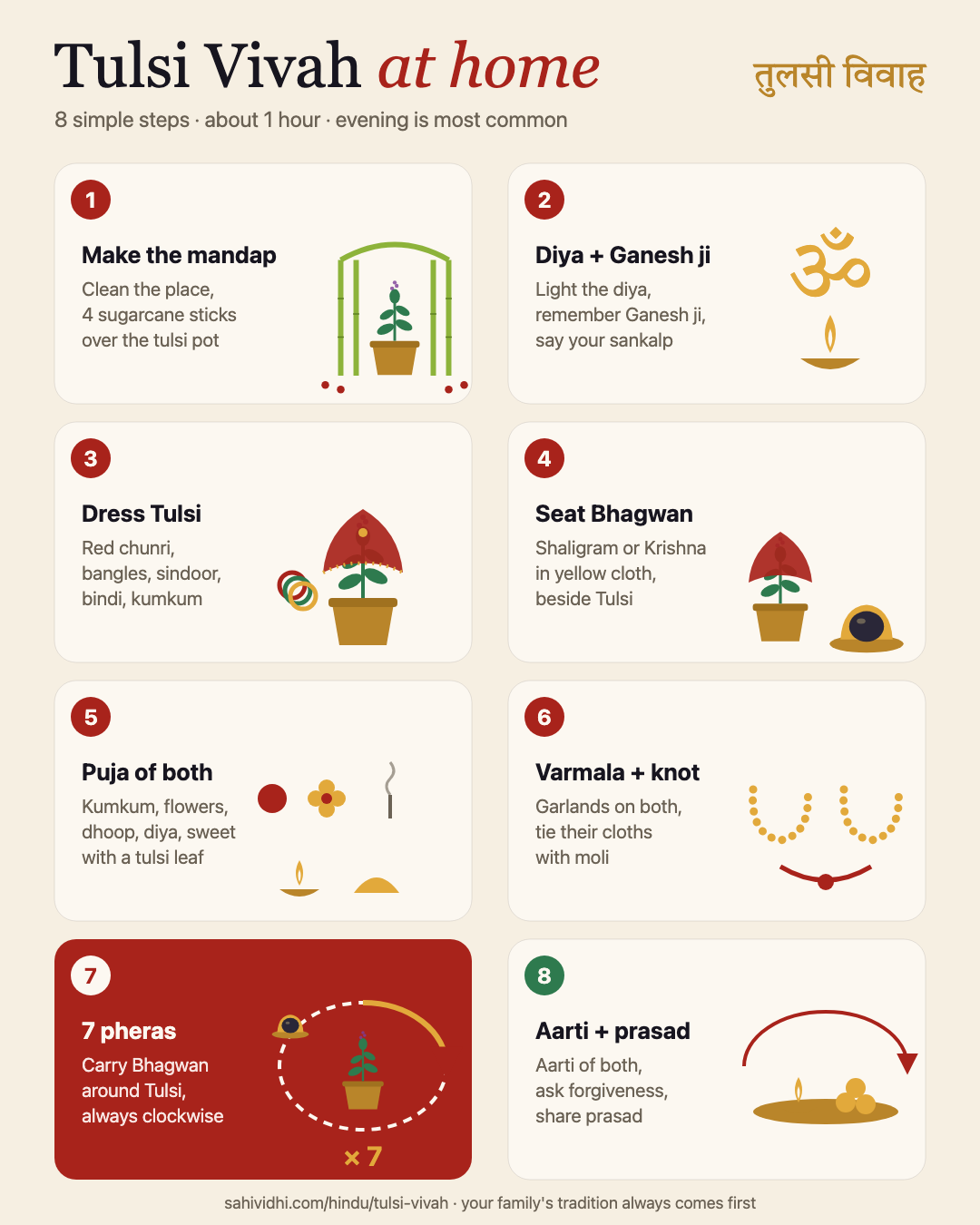
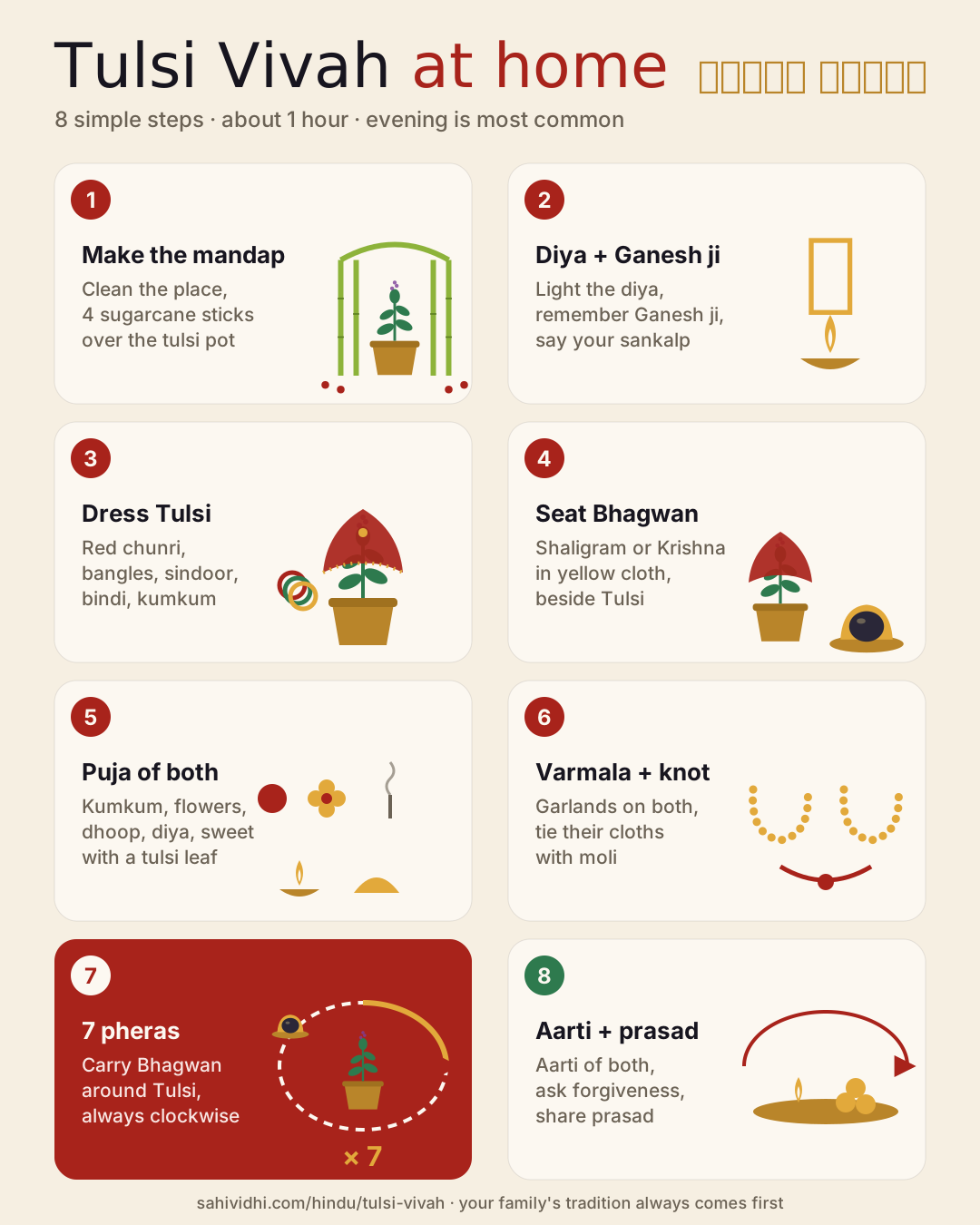
Clean the area around the tulsi pot and draw a rangoli. Tie the four sugarcane sticks over the pot like a wedding mandap. Bathe and wear clean clothes.
Light the diya and begin with Ganesh ji
Light the ghee diya. Remember Ganesh ji, then say your sankalp: your name, the place, and that you are performing Tulsi Vivah.
ॐ गं गणपतये नमःOm Gam Ganapataye NamahSalutations to Ganesh ji, remover of obstacles.Dress Tulsi as the bride
Offer water to the tulsi. Drape the red chunri over the plant and offer the shringar: bangles, sindoor, bindi. Apply kumkum and haldi to the pot.
Seat Bhagwan beside her
Bathe the Shaligram (or wipe the idol), dress Him in the yellow cloth, and place Him on a small chowki or plate next to the tulsi.
Puja of both
Offer to both, in this order: chandan and kumkum, flowers, dhoop, diya, and naivedya with a tulsi leaf.
ॐ तुलस्यै नमः · ॐ नमो भगवते वासुदेवायOm Tulasyai Namah · Om Namo Bhagavate VasudevayaSalutations to Tulsi devi · Salutations to Bhagwan Vasudeva (Vishnu).Varmala and gathbandhan
Place the garlands on both. Tie Tulsi's chunri and Bhagwan's cloth together with moli: the wedding knot. Families who do kanyadaan offer it now.
Seven pheras
Holding the Shaligram (or idol) respectfully in your hands, walk around the tulsi 7 times, clockwise, while the family sings or chants. In a small space, carry Him around the pot itself.
ParamparaSeven pheras, as in a Hindu wedding. Some families do four.
Aarti, prayer and prasad
Do the aarti of both, ask forgiveness for any mistakes, and share the prasad with everyone. Many families also distribute the seasonal fruits.
Samagri as a list
For Tulsi (the bride)
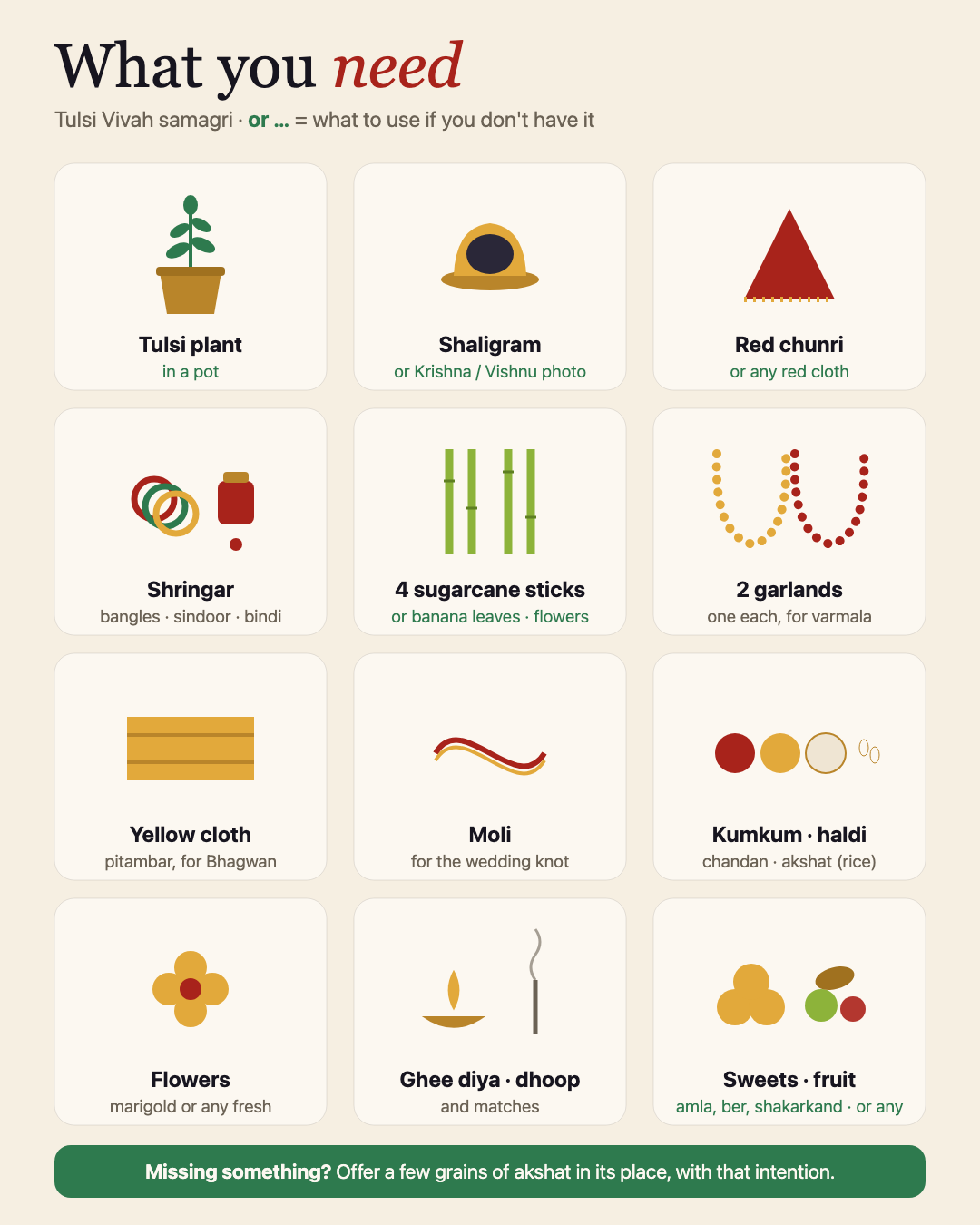
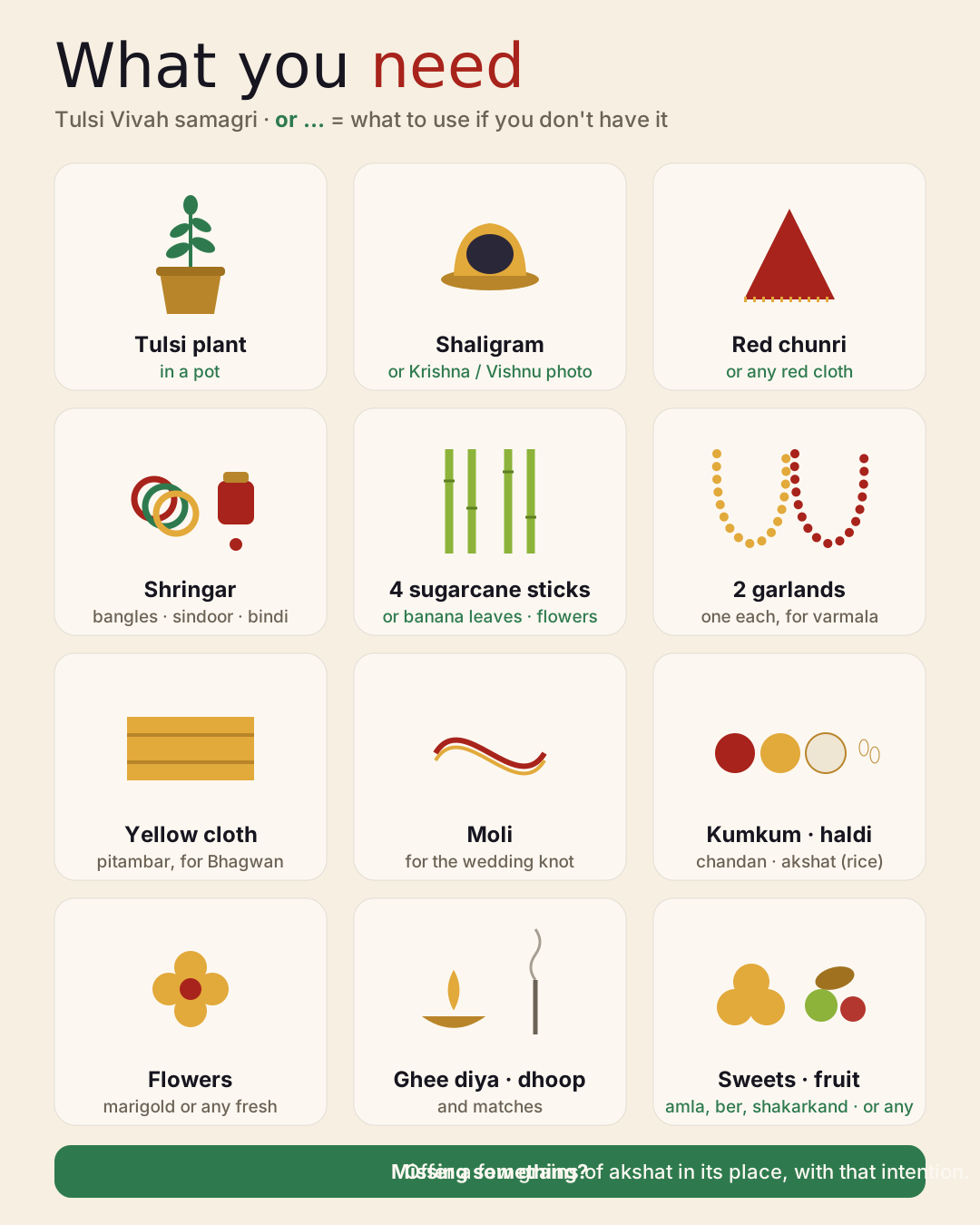
- Tulsi plant in a pot
- Red chunri or a small sari · any red cloth
- Shringar: bangles, sindoor, bindi, a small mirror and comb
- A garland (varmala)
- 4 sticks of sugarcane for the mandap · banana leaves, or flowers and rangoli
For Bhagwan (the groom)
- Shaligram · a Krishna or Vishnu idol or photo
- Yellow cloth (pitambar)
- A garland (varmala)
- A small chowki or plate to seat Him
For the puja
- Kumkum, haldi, chandan, akshat (whole rice)
- Flowers, diya with ghee, dhoop
- Moli (red thread) or a cloth for the gathbandhan
- Water in a lota
Naivedya & prasad
- A sweet: sheera, peda or laddoo
- Seasonal fruit: amla, ber, sitaphal, shakarkand · any fruit
- Tulsi leaf on every offering, picked the day before
ParamparaMissing an item? Offering akshat in its place, with that intention, is the accepted practice.
Do's & don'ts
Do
- Pick the tulsi leaves you need the day before
- Treat it with the joy of a family wedding: sing, invite neighbours
- Share the prasad with everyone present
Avoid
- Plucking tulsi leaves on Agiyaras (many families avoid it)
- Onion and garlic in that day's food
- Rushing: devotion matters more than perfection
६Sources
- Bhagavad Gita 9.26 — a leaf, a flower, a fruit or water, offered with devotion
- The story of Vrinda and Tulsi devi in the Puranas: background reading on Tulasi in Hinduism ↗ and Shaligram ↗ on Wikipedia.
- Tulsi Vivah vidhi as commonly performed in Gujarati homes, simplified. Background reading: Tulasi Vivaha ↗ on Wikipedia.
Also see: Home Mandir Setup · All festivals in your city